2026年9月20日 星期日

week 3. ubiquitous computing and calm technology

1. Broken IT probes 
reference frames: object -> practice -> meanings
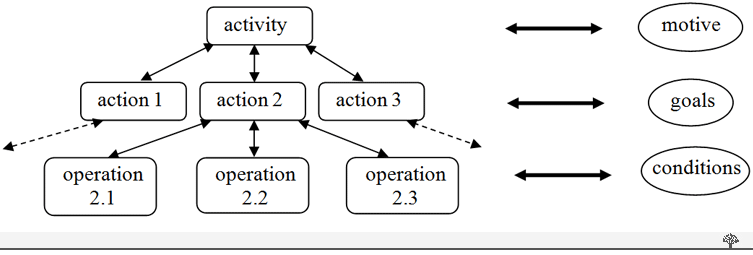
reference theory: activity theory (on interaction design org)


reference book: Understanding Media by McLuhan (麥克魯漢, 認識媒體)

1, 媒體四大律:
增強?削弱?重拾?反轉?
(參考"數位麥克魯漢")

2. hot media vs. cool media (熱媒體 vs. 冷媒體)
3. rear-view mirror (後視鏡理論現象)
4. The medium is the message (媒體即訊息)
5. Understanding media: the extension of man (媒體: 人的延伸)

McLuhan’s tetrad of the media :
  • Enhance: What does the medium enhance, referring to the way in which a new medium enhances or amplifies an existing medium?
  • Obsolete: What does the new medium make obsolete, or in other terms, does the new medium eventually render an existing medium obsolete?
  • Retrieve: What does the medium retrieve that had been obsolesced earlier, referring to how a new medium can bring back something that was previously lost or forgotten?
  • Reverse: What does the medium reverse or flip into when pushed to extremes, describing how a new medium can eventually be used in a way that is opposite to its original intended purpose?
group discussion: 
   find examples of tetrad of the media. (you can ask AI)

References:
  1. Takkeci, Mehmet Sarper, and Arzu Erdem. 2024. "McLuhan’s Tetrad as a Tool to Interpret the Impact of Online Studio Education on Design Studio Pedagogy" Trends in Higher Education 3, no. 2: 273-296. https://doi.org/10.3390/higheredu3020017
  2. McLuhan, M.; Powers, B.R. The Global Village: Transformations in World Life and Media in the 21st Century; Communication and Society; Oxford University Press: New York, NY, USA, 1989; ISBN 9780195079104. [Google Scholar]
  3. McLuhan, M.; McLuhan, E. Laws of Media: The New Science; University of Toronto Press: Toronto, Canada, 1992; ISBN 9780802077158. [Google Scholar]


Thing ethnography?
Thing Constellation?
(The co-occurrence of things) 

Questions:
1. How do we live with data?
2. How do we perceive (feel) the data we live with?
3. What is the form of data to live with?
4. How are the correlation of different data?

EX2: living with data
Conduct an activity to answer the above questions.
consider what if AI can help to create a data fiction?

Presentation date: Oct. 12, 2026.

References:

2026年9月13日 星期日

week 2. self-introduction & IoT presentation

Suggested Presentation & critique guidelines:

1. BPMRC (structure about research, plan, novel idea, ...)
    Background (problem, idea, gap)
    Purpose (better future, intended future)
    Method (framing, approach, tool)
    Result (outcome, expected output)
    Conclusion

2. MEFF (structure about describing a design artifact)
    Material (idea, problem, issue)
    Expression (metaphor, scenarios, emotion)
    Function  (task, path, technology)
    Form (representation, affordance)


Activities:

1. 自我介紹,專長,個人惡趣味。
    students present personal complicated pleasures 
2. Students Present IoT examples
Liang's Publications and Slides:
https://jazzliang.wordpress.com/wp-content/uploads/2008/01/1387-1b.pdf

3. ACM student-research-competition/poster  Kick-off presentation
    What is the plan for design?
    How do you frame your problem?
    Which method do you want to use?
    What approach? Theory driven? Example based? Fictional paper abstract?
    Probing Example:

     Designing Memory Probes to Inform Dialogue

 
     presentation next week: Sept. 21, 2026

   ACM Student Research Competition: (Deadline Jan. 21, 2027)

ACM SIGCHI Posters: (Deadline Jan. 21, 2027)

https://chi2027.acm.org/authors/posters/
(one or multiple authors) 

DIS examples:


ACM DIS paper/ pictorials 
  • January 11th, 2027, Full paper and Pictorials Abstract and Title
  • January 18th, 2027 –  Full papers, Pictorials


4. Discussion on Weiser's "The computer for 21st Century"
"The most profound technologies are those that disappear.
They weave themselves into the fabric of everyday life until
they are indistinguishable from it."

Reference:
"Smart Mobs: The next social revolution" Chapter 4.
"聰明行動族" 第四章 pp. 129~175


EX1: Broken IT probes (Oct. 5, 2026)
1. collect at least one "out-of-date" (old, worn) IT (information technology) product.
2. how do you repair the IT product? Does it work? Which technology goes out-of-date or completely disappears?
3. What did this IT replace the other things in old days? By what object is this IT product replace.  
4. How do you frame this IT product in terms of technology, practice, ritual, meanings...
5. Consider what if AI can help analyzing probes data?

Upload to Google drive (shown in FB community)

舊書修復: (repairing the old book)

2026年9月3日 星期四

week 1. introduction

How this course goes:

1. 學生為主體的學習 (報告、討論、帶領工作坊、參與競賽)
    Students as learning subjects (report, discussion, workshop holding, competition)

2. 自主學習設計方法、設計工具、設計流程。
    self learning design methods, design tools, design process

3. 自行蒐集設計資料、定義問題、製作設計工具。
    self collecting data, framing problems, making design tool

4. 自行訂定設計評估方法,使用者調查方法。
    self designing evaluation methods, user study methods

學習內容:
What to learn:

1. 互動設計領域重要論文研讀 (Ubi-comp, Tangible interaction, Calm tech, / Slow tech, critical/reflective/ludic/speculative design, material interaction)

2. 互動設計研究方法學 (probology, research through design, / dialogical meaning-making, phenomenology)

3. 互動設計個案實作 (SIGCHI/DIS submission)

個人報告  (Sept. 14, /2026)
1. 自我介紹 (self-intro)
2. 惡趣味介紹 (complicated pleasure sharing)
3. 智慧型設計分享 (IOT examples) 九組擇一分享。(choose one category to share next week in classroom) (What is IOT?)

競賽相關
course outcomes targeting:

ACM CHI 2027 Student Research Competition


1. 組隊 (2-5 人/隊) (2-5 students as a team)
2. 報告比賽規則, Q&A, discussion (Sept. 9, 2026)


期末: (final)

 組隊投稿 ACM 學生設計競賽/SIGCHI  Posters。
 Team up to participate ACM Student Research Competition or SIGCHI Posters.

ACM Student Research Competition: (Deadline Jan. 21, 2027)

https://chi2027.acm.org/authors/student-research-competition/
(only one author for graduate students)

ACM SIGCHI Posters: (Deadline Jan. 21, 2027)

(one or multiple authors) 


Examples in the previous semesters:

Objects Gossip (CHI'26)


Once Upon a Future (DIS'18)

Craft consciousness (CHI'15)

Readings:
Mark Weiser, Computer for the 21st Century

評分方式: (Grading)
1. 個人表現 60% + 團隊表現 40 %
    Personal performance 60% + Team performance 40 %

2. 評分項目: 課堂出席、參與討論﹐、互相評論、競賽作品完整度。
    Evaluation items: course participation, discussion, critique, completeness of ACM competition

加入課程群組:
join course group (course syllabus updated every week) :