2018年9月30日 星期日

week 4. ubiquitous computing and calm technology

1. Broken IT probes presentation

object -> practice -> meanings

媒體四大律:
增強?削弱?重拾?轉化?
(參考"數位麥克魯漢")

Ubiquitous Computing

Discussion on
Mark Weiser, Computer for the 21st Century
Mark Weiser, Designing Calm Technology

Questions:
1. How do we live with data?
2. How do we perceive (feel) the data we live with?
3. What is the form of data to live with?
4. How are the correlation of different data?

Conduct an activity to answer the above questions.
Presentation date: Oct. 15, 2018.

Case study:
Objects of Research

Ambient Devices (where is ambient orb or umbrella?)


Reference:
Ambient Intelligence
connected home product
Experiencing the Affective Diary
Reflecting on the design process of the Affective Diary

Enhancing ubiquitous computing with user interpretation: field testing the home health horoscope


2018年9月16日 星期日

week 2. self-introduction & IoT presentation

Suggested Presentation & critique guidelines:

1. BPMRC
    Background (problem, idea, gap)
    Purpose (better future, intended future)
    Method (framing, approach, tool)
    Result (outcome, expected output)
    Conclusion

2. MEFF
    Material (idea, problem, issue)
    Expression (metaphor, scenarios, emotion)
    Function  (task, path, technology)
    Form (representation, affordance)


Activities:

1. 自我介紹,專長,個人惡趣味。
2. Students Present IoT examples

https://www.postscapes.com/internet-of-things-examples/

3. ACM student design competition Kick-off presentation
    What is the plan for design?
    How do you frame your problem?
    Which method do you want to use?
    What approach? Theory driven? Example based? Fictional paper abstract?
    Probing Example:

     Designing Memory Probes to Inform Dialogue

 
    Next presentation: Oct. 1, 2018

  2019 ACM student design competition
  2019 ACM CHI Late-breaking work
  DIS 2019 (Designing Interactive System)Contesting Borders and Intersections 
   DIS pictorial example
   DIS pictorial example Botanic Printer

3. Discussion on Weiser's "The computer for 21st Century"

EX1: Broken IT probes (Oct. 1, 2018)
1. collect at least one "out-of-date" (old, worn) IT (information technology) product.
2. speculate with the object's viewpoint
3. complete a secrete-life diary of the object
上傳到:
  https://drive.google.com/open?id=1j_nYgFe1IFRxUrb-Gcbyh_Ag5GcB2BMp

舊書修復:

2018年9月9日 星期日

week 1. introduction


1. 學生為主體的學習 (報告、討論、帶領工作坊、參與競賽)
    Students as learning subjects (report, discussion, workshop holding, competition)
2. 自主學習設計方法、設計工具、設計流程。
    self learning design methods, design tools, design process
3. 自行蒐集設計資料、定義問題、製作設計工具。
    self collecting data, framing problems, making design tool
4. 自行訂定設計評估方法,使用者調查方法。
    self designing evaluation methods, user study methods

學習內容:
1. 互動設計領域重要論文研讀 (上學期: Ubi-comp, Tangible interaction, Calm tech, slow tech,  下學期: critical/reflective/ludic/speculative design, material interaction)
2. 互動設計研究方法學 (上學期: probology, research through design, 下學期: dialogical meaning-making, phenomenology)
3. 互動設計個案實作 (上學期: SIGCHI/DIS submission, 下學期: TEI/other submission)

個人報告  (Sept. 11, /2018)
1. 自我介紹 (self-intro)
2. 惡趣味介紹 (complicated pleasure sharing)
3. 設計個案(https://www.postscapes.com/internet-of-things-examples/) 擇一分享。

競賽相關
1. 組隊 (2-5 人/隊)
2. 報告比賽規則, Q&A, discussion (Sept. 11., 2018)

期末: (final)

 組隊投稿 ACM 學生設計競賽/SIGCHI  Late-Breaking Work。
 Team up to participate ACM Student Design Competition or SIGCHI Late-Breaking Work.

ACM Student Design Competition: (Deadline Jan. 7th, 2019)

http://chi2019.acm.org/authors/student-design-competition/

ACM SIGCHI Late-Breaking Work:

http://chi2019.acm.org/authors/late-breaking-work/

Example:

Craft consciousness
footpal team 2010
paper
BlindNavi 2015

Readings:
Mark Weiser, Computer for the 21st Century

評分方式: (Grading)
1. 個人表現 60% + 團隊表現 40 %
    Personal performance 60% + Team performance 40 %
2. 評分項目: 課堂出席、參與討論﹐、互相評論、競賽作品完整度。
    Evaluation items: course participation, discussion, critique, completeness of ACM competition

2017年5月21日 星期日

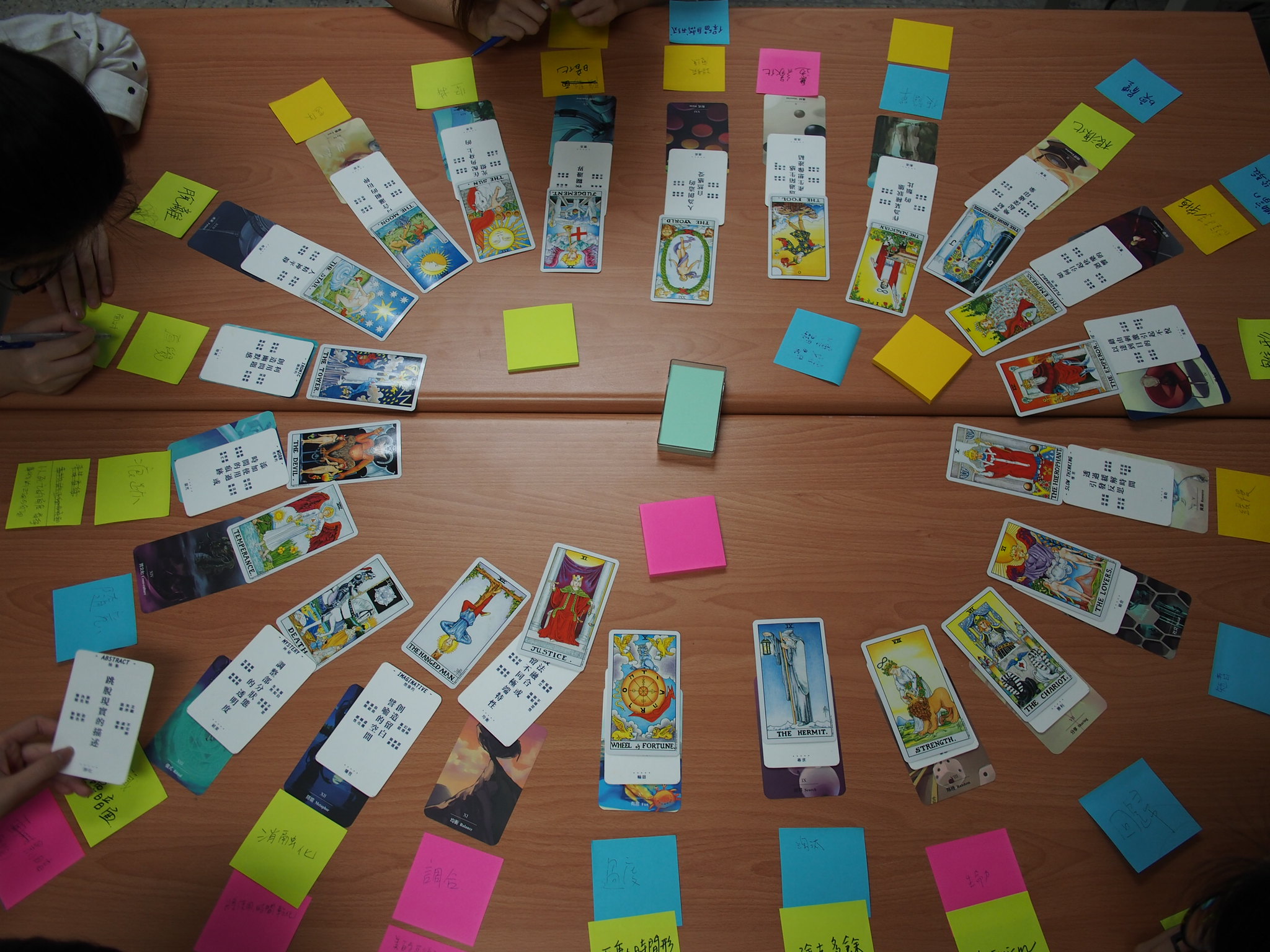
week 14. revisit Interaction Design Tarot


Discussion on Wabi-sabi & final project proposal

塔羅牌義

占星關鍵字

Poetic  相關字:

uncertain, unknown, abstract, ironic, fun, mystery, unfinalized, serendipity, absurdity, playful, paradoxical, ambiguity, vague, evocative, old, worn, imaginative, pure-geometry, repeating, hypnotic, spiritual, ludic, animism, provocative, useless, foregrounded, sychronicity, rustic, subconscious, fictional, wabi-sabi, zen, mindful

Questions:
Wabi-sabi 相關字有哪些? 如何 mapping 到 1. 四個 elements (earth, water, fire, air), 2. Tarot?


Susanne Langer 的符號學
巴舍拉 火的精神分析, material imagination


P5223340


2017年5月7日 星期日

week 12. material interaction and materiality

1. student presentation on Wabi-sabi cases and design principles.


PUC theme issue: material interactions, 2014. (special issue, PUC)


special issue on PUC
material interaction : ‘‘post-representational interaction design’

"The notion of ‘‘Materiality’’ is now being applied in a
number of different academic disciplines including physics
[1], politics [4], philosophy [37], sociology [8, 9, 27],
architecture [14, 39], and archeology [16]."

"These information systems-related areas have always
focused on the immaterial dimensions of our world—on
representations of things—and the differences between
‘‘real’’ and virtual, or ‘‘physical’’ and ‘‘digital.’’"


Electric materialities and interactive technology, James Pierce, 2013


2017年4月30日 星期日

week 11. material talks and methodology

Understanding agency in interaction design materials, 2012. (material talks back)


Methodology for materiality: interaction design research through a material lens, Wiberg, 2013. (Methodology)


material-centered design vs. user-centered design

Questions:
1. How to relate "material talks" concepts to Wabi-sabi ?
2. How to apply Wiberg's methodology to wabi-sabi aesthetics and HCI design?